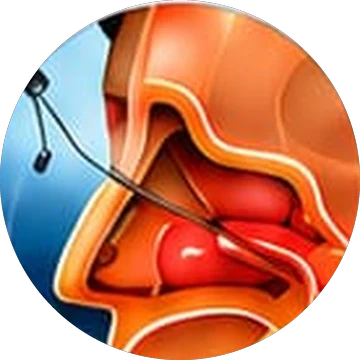
A deviated septum narrows one or both sides of the nose. Using an endoscope, the bent cartilage and bone are corrected precisely from inside the nose, improving breathing, reducing headaches and helping sinus drainage.
Nose & Sinus Surgery
Endoscopic Septoplasty
Straightening a deviated nasal septum through the nostrils — no external cut, no visible scar.
About Endoscopic Septoplasty
AnaesthesiaGeneral or local with sedation
Duration45 – 60 minutes
Hospital stay1 night
Back to routine1 – 2 weeks
When is it recommended?
- One-sided or both-sided nasal block
- Frequent nose bleeds
- Headache & facial pressure
- Snoring due to nasal obstruction
How the procedure is done
- 1
Nasal endoscopy
The exact position of the bend is mapped with an endoscope (and CT scan if needed).
- 2
Incision inside the nose
A small cut is made inside the nostril — nothing on the outside of the nose.
- 3
Correcting the septum
The bent cartilage and bone are trimmed, straightened and repositioned under endoscopic vision.
- 4
Splints or packs
Soft splints or light packing may be placed for a short time to support healing.
Benefits
No external scar; shape of the nose is unchanged
Better breathing through both sides
Less snoring and fewer sinus infections
Can be combined with sinus or turbinate surgery
Recovery & aftercare
The nose feels blocked for the first week. Saline sprays, steam and medicines help. Avoid blowing the nose hard, heavy lifting and dusty places for 2 weeks. Full results are felt in 4–6 weeks.
Related conditions
Deviated Nasal SeptumA bent partition inside the nose that blocks breathing on one or both sides.Snoring & Sleep ApnoeaLoud snoring, sometimes with pauses in breathing during sleep — causes can be in the nose…Chronic SinusitisLong-lasting inflammation of the sinuses causing blocked nose, facial pressure and…
Frequently asked questions
No. Septoplasty corrects the inside partition; the outer shape stays the same.
Light packs or soft splints may be used for a short time; they are removed at follow-up.
This page is for general patient information and does not replace a medical consultation. The right treatment depends on your examination and test results.
Struggling with an ear, nose or throat problem?
Get an expert opinion from an ENT surgeon trained in endoscopic, microscopic and coblation techniques.
